
A tulip border in May is hard to argue with. Fat red Darwins, ruffled parrots, doubles the colour of raspberry ripple — they earn their place every spring. Yet the tulips that quietly reappear in the same gravel path for a decade are usually a different sort of plant altogether: small, sharp and close to their wild ancestors. Knowing the difference between species tulips and hybrid tulips changes what you buy, where you plant it, and how much work you sign up for each autumn.
What Counts as a Species Tulip?
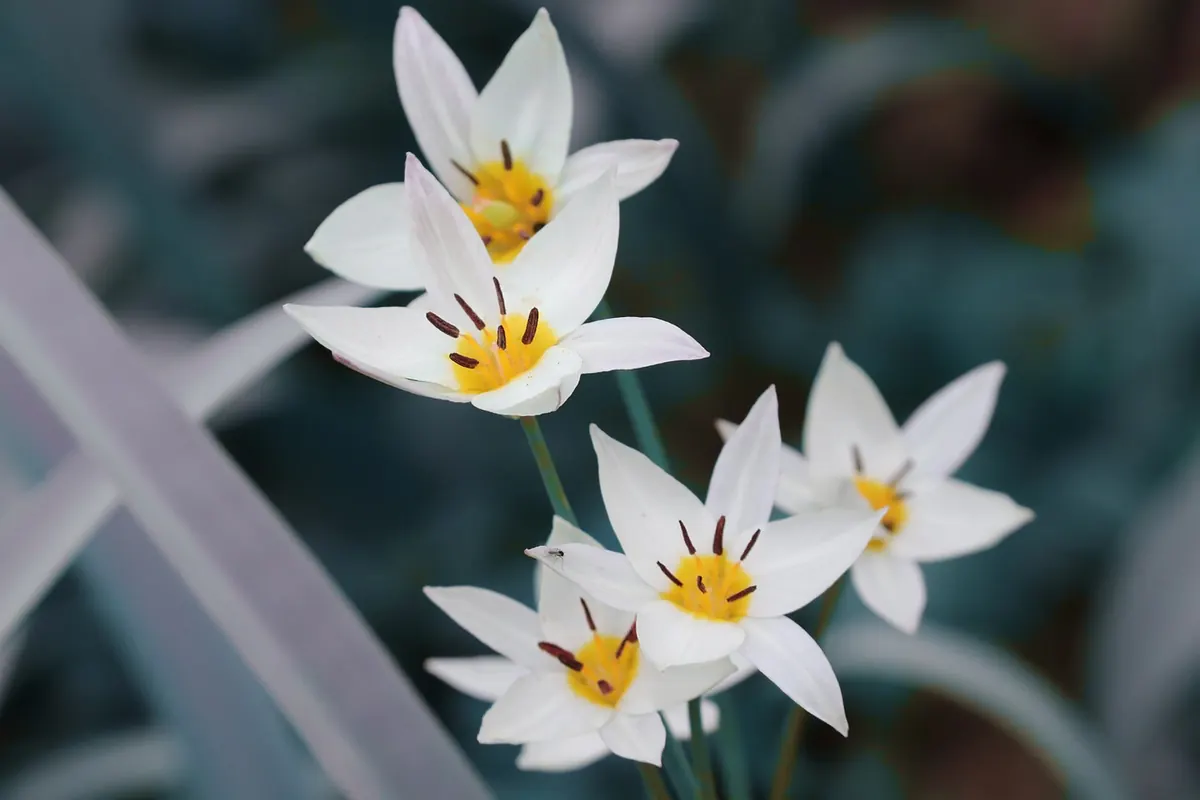
Species tulips — often sold as botanical tulips — are the wild tulips of Turkey, Iran, Central Asia and the Mediterranean, plus a few that settled in Britain centuries ago, such as Tulipa sylvestris. They are grown more or less as they grow in the wild: small bulbs, modest leaves, flowers held low to the ground.
Names worth knowing include Tulipa humilis, T. clusiana, T. tarda, T. batalinii, T. sprengeri, T. fosteriana and T. kaufmanniana. The last two are wild species that have been bred into named garden forms, so you will see cultivars of them sold alongside the true species. Judge by behaviour rather than the label: if it multiplies, self-seeds and shrugs off a dry summer, it is doing the species job.
Why Species Tulips Come Back
The great virtue of species tulips is permanence. They are not bred for one enormous flower at the expense of everything else. Their bulbs divide steadily, their seed germinates in gravel and thin grass, and their foliage is small enough to die back without leaving a bald patch in the border. In free-draining soil and full sun, clumps can persist for years with nothing more than a tidy-up after flowering.
They also stretch the season at both ends. Tulipa kaufmanniana and T. humilis open in March and early April, when little else is out; T. sprengeri flowers in late May and into June, long after most hybrids have gone over. Against that, the flowers are small — often no bigger than a fifty-pence piece — and the colour range is limited to reds, yellows, whites, pinks and lilacs, usually with a contrasting blotch at the base.
What Modern Hybrids Do Best
Hybrid tulips are bred for impact: uniform height, hefty blooms, strong stems and a colour palette that runs from near-black to softest apricot. Darwin hybrids, Triumphs, lily-flowered, fringed, parrot and double varieties all belong here. They are the right choice for a bedding scheme that has to look deliberate on a particular date, for containers by a front door, and above all for cutting, where a long straight stem matters more than a plant's long-term future.
The trade-off is cost and effort. Many hybrids flower brilliantly once and then sulk, splitting into small non-flowering bulbs or fading away altogether. Tulip fire, a fungal problem that disfigures leaves and flowers, builds up in soil where the same stock is replanted year after year. Serious growers treat bedding hybrids as annuals: plant fresh bulbs in autumn, lift them after the foliage yellows, and start again somewhere else. Some do return reliably — Darwin hybrids, Triumphs and the fosteriana and kaufmanniana cultivars are the best bets in well-drained ground.
Size, Colour and Scent Compared
Height and flower size
Species tulips generally sit between 10cm and 30cm, with T. sylvestris and T. sprengeri reaching perhaps 40cm. Hybrids commonly run from 35cm to 70cm, which is why they work in borders and species tulips do not. A 15cm scarlet T. linifolia in a lawn will be lost; the same plant in a gravel trough or at the edge of a path stops people in their tracks.
Colour and scent
Species tulips tend to be more saturated and more subtle at once, with neat basal markings that reward a close look. Hybrids give you the pastels, the near-blacks, the heavy doubles and the striped and fringed forms. Scent is hit and miss in both camps, though some species — T. humilis and T. batalinii among them — carry a light, sweet fragrance on a warm afternoon.
Matching Tulips to a Place in the Garden
Think about where the plant will live before you order anything.
- Gravel and rock gardens: species tulips, planted among alpines where the soil bakes in summer.
- Rough grass and lawns: T. sprengeri, T. sylvestris and T. tarda, left to seed and mown only after the leaves die down.
- Front of a sunny border: T. humilis, T. batalinii and kaufmanniana cultivars, where their early colour lifts the whole bed.
- Containers: hybrids, refreshed each autumn for a guaranteed show.
- Cutting garden: long-stemmed hybrids — Darwin and Triumph sorts — planted in rows and lifted each year.
- Wildflower or meadow planting: species only; hybrids seldom set useful seed and disappear.
Planting and Aftercare: The Real Differences
Autumn is the moment that decides next spring, and the two groups want slightly different treatment.
Species tulips
Plant from September to November, about 10–15cm deep, in full sun and soil that drains within an hour of heavy rain. If your soil is heavy clay, dig in grit or grow them in raised beds and pots. Do not water them through summer — a dry dormancy is what keeps the bulbs healthy. Leave the seedheads if you want them to spread, and lift and divide crowded clumps only when flowering thins out.
Hybrid tulips
Plant 15–20cm deep, pointed end up, in October or November. Space them about 10cm apart for bedding, closer in pots. If you intend to keep the bulbs:
- Deadhead as each flower fades, but leave the stem and leaves intact.
- Water in dry springs and give a balanced liquid feed while the leaves are green.
- Wait at least six weeks after flowering before clearing the foliage — the bulb is refilling.
- Lift in summer once leaves have yellowed, dry the bulbs somewhere airy, and store them cool until autumn.
- Never replant tulips in the same spot for more than two or three years running, and bin any bulb showing brown streaks or mouldy patches rather than composting it.
So Which Should You Grow?
Most gardens suit a mix. Use species tulips where you want permanence and low maintenance — gravel, rockeries, the edge of a path, thin grass under a fruit tree — and accept their small scale as part of the charm. Use hybrids where you want a spectacle on a date you can plan for, in pots, beds and cutting rows, and be prepared to replant them.
If you are new to tulips, start with a handful of T. humilis or T. tarda in the sunniest, sharpest-drained corner you have, and a pot of Darwin hybrids by the door. One will teach you how little tulips need; the other will remind you why the fuss is worth it.
Photo: manfredrichter / Pixabay