
A bunch of tulips bought on a Friday can look tired by Tuesday: petals dropping, stems curling, water cloudy. Grow the right varieties, though, and a single stem can hold its shape for a fortnight. Most of that difference is in the bulb. Class, breeding and stem strength matter far more than any trick you add to the vase afterwards. What follows are ten tulips that cut and last well, plus the cutting and conditioning habits that keep them upright and fresh.
What separates a good cut tulip from a pretty one
Tulip classes behave differently once they leave the ground. Triumph and Darwin Hybrid types have the stiffest stems and the neatest, most upright flowers, which is why they dominate the cut-flower trade. Single Lates flower later, on the longest stems of all, and are the classic May cutting tulip. Viridifloras are unfashionably sturdy and last beautifully. Lily-flowered sorts bring elegance, though their slimmer stems need a sheltered spot.
Doubles and Parrots are wonderful in a border and disappointing in a vase: the heavy heads droop and the petals bruise. Single Earlies and most species tulips are simply too short to cut with any confidence.
- Stem length: 40cm or more for a decent vase, 50cm for a generous bunch.
- Bud shape: look for an upright, egg-shaped bud that stays cupped rather than flopping open on day one.
- Substance: firm, green, snappy stems, never limp or hollow-feeling.
Ten tulips to grow for the vase
- Apeldoorn (Darwin Hybrid). Scarlet red with a black and yellow base, on a stem that shrugs off wind and rain. Cut it while the bud is still closed, because the wide flower opens fast in a warm room.
- Pink Impression (Darwin Hybrid). Soft pink, big flowers, thick stems. Reliable in a mixed bunch, and it returns reasonably well if you leave the foliage to die back naturally.
- White Dream (Triumph). Creamy white and formal, widely grown for the cut-flower trade. It holds its shape for a long time, which makes it a sensible choice for a single-colour vase.
- Strong Gold (Triumph). Clear yellow, upright and sturdy, with the tight egg-shaped bud florists favour. Cut it on the tight side and it will open slowly indoors.
- Passionale (Triumph). Deep purple that reads almost black in low light. The colour holds in water rather than fading to a tired grey.
- Barcelona (Triumph). Rich magenta-pink on tall, robust stems, with generous flowers. It travels well if you are picking for someone else.
- Couleur Cardinal (Triumph). Dark red with a plum flush and a neat, upright habit. A little shorter than the rest, so it suits a low, dense arrangement.
- Mariette (Lily-flowered). Slim, pointed, magenta-pink petals that give a bunch some air. The stems are thinner, so plant it out of the wind; in the vase it behaves impeccably.
- Queen of Night (Single Late). The deepest maroon-purple you can grow, on long stems. Single Lates are the traditional cutting tulips, and this one is superb against white or acid green.
- Spring Green (Viridiflora). White petals feathered with green, so it sits happily alongside foliage. Sturdy, understated and one of the longest-lasting here.
Cutting at the right moment
Cut in the morning, when stems are full of water. Take a clean bucket of cool water into the garden and plunge each stem straight into it. The bud should be coloured and swelling but still closed for Triumphs and Darwin Hybrids; Single Lates can be slightly further on. Cut at a sharp angle rather than straight across, which gives more surface for water uptake. If you want the bulbs to flower well again next spring, leave at least two leaves on each plant so it can rebuild its reserves.
Conditioning: the first hour matters most
- Strip the lower leaves that would sit below the waterline, but handle the stems gently.
- Re-cut 2–3cm from the base at an angle, using a sharp knife or clean secateurs rather than blunt scissors, which crush the tissue.
- Stand the stems deep in cool water in a cool, shaded room for at least an hour, ideally overnight.
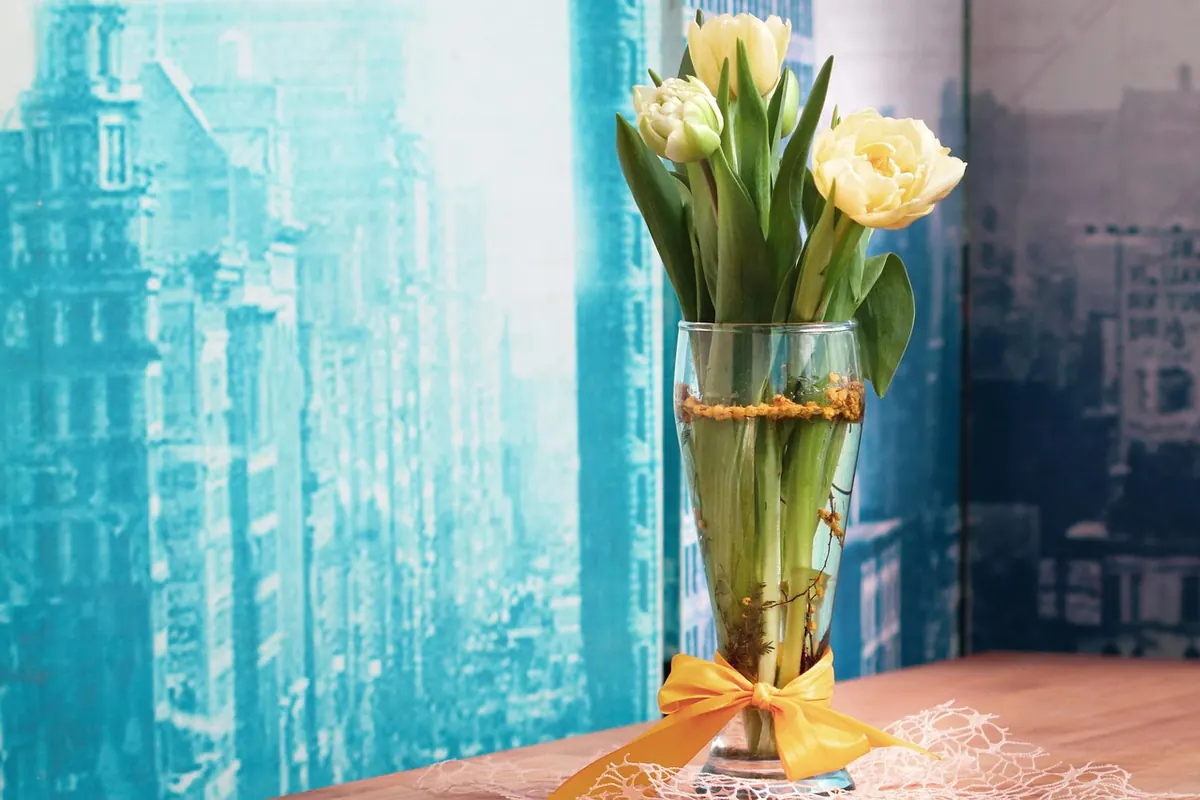
- Arrange them in a tall, narrow vase. Tulips continue to grow by a few centimetres in water and bend towards the light; a narrow neck holds them straight while a wide bowl lets them splay.
- Change the water daily and re-cut the stems every couple of days. Fresh, clean water matters more than any additive.
- Keep the vase away from radiators, direct sun and the fruit bowl. Ripening fruit releases ethylene, which shortens the life of cut flowers.
- Never mix tulips with daffodils. Daffodil sap flows into the water and damages other stems; if you must combine them, condition the daffodils separately in their own water for several hours first
Photo: Van3ssa_ / Pixabay